Dorset has just endured one of its wettest winters on record, with rainfall reaching nearly double the long-term average in places. Combine that volume of water with the county’s widespread clay soils and the result is all too familiar: lawns that stay spongy for weeks, patios that turn into shallow lakes, and gardens that become unusable just when you want to enjoy them.
Key Areas We Will Cover
Why clay soils and heavy winter rain create such a local problem in Dorset
How to diagnose the real cause of waterlogging
French drains: the reliable workhorse for collecting and redirecting water
Permeable bases and surfaces that stop water ponding on hard landscaping
Soakaways: how and when they work (and when they need careful design)
Combining drainage solutions with hard landscaping for lasting results
When professional help makes the difference
Why Garden Drainage Problems Are So Common Across Dorset
Much of Dorset sits on heavy clay, including areas of Oxford Clay and similar impermeable formations. Clay particles pack tightly together, leaving very little space for water to move through. When the ground is already saturated from successive wet days, rain simply sits on the surface or seeps sideways into the lowest points of the garden.
Hard landscaping compounds the issue. Traditional impermeable patios, paths and driveways shed water rapidly onto adjacent lawns and borders. Without proper falls, channel drains or permeable construction, that runoff has nowhere useful to go. The result is soggy lawns that struggle to recover, moss-prone grass, stressed plants whose roots lack oxygen, and patio surfaces that remain wet and slippery long after the rain has stopped.
Diagnosing the Problem on Your Property
Before choosing a solution, it helps to understand what is happening. Look for:
Standing water that remains more than 24 hours after rain
Spongy or muddy patches that never firm up
Moss replacing grass in low areas
Water running towards the house or pooling against walls and patio edges
Soil that feels sticky and cold when wet and cracks when dry
A simple percolation test gives useful information. Dig a hole roughly 300 mm wide and 300–600 mm deep in the worst area, fill it with water, and time how long it takes to drain after the surrounding soil has been saturated. Very slow drainage points strongly towards clay or compaction that will need more than surface treatment.
French Drains: Collecting and Redirecting Excess Water
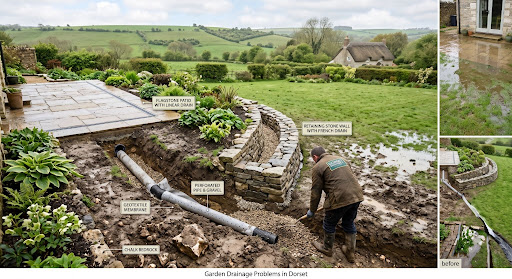
A French drain remains one of the most effective solutions for waterlogged lawns and borders on clay. It consists of a trench, typically 300–450 mm wide and 450–750 mm deep, lined with geotextile membrane, filled with clean angular gravel, and containing a perforated pipe laid to a consistent fall.
Water enters the gravel and pipe and is carried away to a suitable outfall, most often a soakaway or lower part of the garden. Laid in a herringbone pattern under a lawn or as a single interceptor drain at the base of a slope or along the edge of a patio, French drains intercept both surface runoff and shallow groundwater before it can saturate the root zone.
Correct gradient, clean aggregate, proper geotextile wrapping and a reliable outfall are essential. Poorly installed systems silt up and fail within a few years.
Permeable Bases and Surfaces for Patios and Paths
Many patio flooding problems start with impermeable construction and inadequate falls. Replacing or redesigning hard surfaces with permeable options allows rainwater to pass through the surface into a carefully prepared sub-base rather than running off onto the lawn.
Permeable block paving, resin-bound surfaces over open-graded bases, and gravel systems all reduce runoff. Even where traditional paving is preferred, installing a permeable sub-base with appropriate drainage channels or linear drains at the edges prevents water from ponding or spilling into soft landscaping. Correct falls away from the house (typically 1:60 to 1:80) remain fundamental.
Soakaways: Dispersing Water Safely Underground
A soakaway is an underground void, traditionally a rubble-filled pit or, more effectively, modular plastic crates, that temporarily stores water and allows it to infiltrate slowly into the surrounding soil. Building Regulations require soakaways to be sited at least 5 m from buildings and to be sized according to a percolation test.
On heavy clay the infiltration rate is often low, so soakaways need to be larger, shallower and wider, or paired with a French drain network that spreads the load. In some Dorset locations a high winter water table further limits performance, making professional assessment essential. When designed correctly for the soil conditions, soakaways provide a compliant and sustainable outfall without relying on the main sewer.
Combining Drainage with Hard Landscaping for Permanent Results
The most reliable outcomes come from treating drainage and hard landscaping as a single system. A new patio can be designed with falls towards discreet channel drains that feed into a French drain or soakaway. Lawns can be regraded slightly and under-drained before new turf is laid. Borders can incorporate gravel drainage strips or rain gardens that accept overflow during extreme events.
This integrated approach prevents the common situation where a beautiful new patio simply moves the water problem a few metres into the lawn. It also protects the investment: well-drained ground supports healthier planting, longer-lasting paving and outdoor spaces that can be used more of the year.
Practical Steps You Can Take Now
While major systems benefit from professional design and installation, several measures help in the short term:
Aerate compacted lawns with a hollow-tine aerator when the ground is moist but not saturated, then brush in a sandy top-dressing mix.
Add organic matter (well-rotted compost or leaf mould) to borders to improve structure over time.
Keep gutters and downpipes clear and consider diverting roof water into a dedicated soakaway or water butt system.
Avoid walking on saturated lawns, which worsens compaction.
These steps reduce surface waterlogging but will not overcome deep clay or significant runoff from hard surfaces on their own.
Conclusion
Garden drainage problems in Dorset are driven by the combination of clay soils and heavy winter rainfall. Soggy lawns and patio flooding are not inevitable. French drains collect and move water, permeable bases reduce runoff at source, and properly designed soakaways disperse it safely. When these elements are combined thoughtfully with hard landscaping, the result is a drier, more usable and more resilient outdoor space.
Understanding the specific conditions on your plot, testing the soil, and planning an integrated solution delivers the most reliable long-term improvement.
Get Started Today
If your Dorset garden struggles with waterlogging every winter, the team at Forevergreen Services is ready to help. With more than twelve years of local experience, we carry out free on-site assessments, provide clear transparent quotations, and design drainage solutions that work with your existing or planned hard landscaping. Call us on 01305 564864, email Info@forevergreenservices.co.uk, or visit us at Unit 8 Lower Burton Farm Buildings, Dorchester, Dorset, DT2 7RZ to arrange a no-obligation visit.
Frequently Asked Questions About Garden Drainage in Dorset
These answers address the questions we hear most often from homeowners dealing with soggy lawns and flooded patios.
Why does my lawn stay wet for days after rain in Dorset?
Heavy clay soils common across much of the county drain very slowly. Once saturated by successive wet days, additional rainfall has nowhere to go and remains on or near the surface.
Will a French drain work on clay soil?
Yes. French drains are particularly effective on clay because they intercept water and move it elsewhere rather than relying on the soil to absorb it. Success depends on correct installation and a suitable outfall.
Do soakaways work in Dorset’s clay?
They can, but they must be sized and positioned according to a proper percolation test. On very heavy clay they often need to be larger and shallower, or combined with a collection network such as French drains.
Can I fix patio flooding without replacing the whole patio?
In many cases yes. Adding channel drains at the edges, improving falls where possible, or introducing permeable margins can significantly reduce ponding and runoff onto the lawn.
When should I call a professional rather than attempting a DIY fix?
If waterlogging affects a large area, threatens the house foundations, involves complex levels, or requires connection to a soakaway that must meet Building Regulations, professional design and installation is the safer and more cost-effective route.